

Answering: Can I convert my large Melbourne heritage property into a multi-generational family compound?
Estimated reading time: 9 min read
Yes, you can convert your large Melbourne heritage property into a multi-generational family compound, with most properties over 1,200 square metres in Toorak, Canterbury, Brighton and Kew able to accommodate multiple independent dwellings while preserving heritage character. The process requires navigating heritage overlay requirements, designing for both togetherness and privacy, and working within Victorian Planning Provisions Clause 43.01 to create separate living spaces that respect the original architecture and garden setting. Based on BY Projects Architecture’s delivery of 235+ dwellings across 59 heritage overlay projects, including the complex Fairfield church-to-8-dwellings conversion, families across Boroondara and Stonnington are successfully creating private compounds where three generations share one title with complete independence.
You’re likely weighing significant concerns. Will heritage restrictions prevent you from creating genuine independence for each generation? Can you add modern amenities without compromising the character that drew you to the property? And how do you maintain family wealth through single-title ownership while giving adult children or ageing parents their own front door? These questions keep Melbourne families with $1M-2M+ budgets hesitating, unsure whether their vision is even possible under heritage controls.
The reality is success depends on three factors: your property’s specific heritage overlay requirements, the relationship between proposed additions and the original building, and your architect’s experience navigating council processes. Properties in Toorak face different considerations than those in Hawthorn. Heritage Victoria focuses on preserving significant views, mature trees and architectural features rather than preventing all change. Understanding this distinction saves months in approvals.
Multi-generational compound conversions represent the intersection of multi-residential design and heritage adaptive reuse, drawing on expertise developed across Melbourne’s most complex council areas. This guide walks you through the process transforming Toorak estates and Canterbury properties into private family sanctuaries.
Key Insights
- Heritage overlays guide change rather than prevent it, meaning your 1,200+ square metre property likely has more development potential than you realise.
- The key lies in maintaining grand street presence while cleverly concealing additional dwellings within the existing envelope or garden.
Keep reading for full details below.
Table of Contents
- Understanding Multi-Generational Heritage Conversions
- Navigating Council and Heritage Requirements
- Design Strategies for Toorak and Canterbury Estates
- Frequently Asked Questions
- Want to Learn More?
- Citations
Understanding Multi-Generational Heritage Conversions
Heritage overlays work as guidance rather than barriers when approached with expertise. The Victorian Planning Provisions Clause 43.01 Heritage Overlay establishes how changes should respect original architecture and garden settings, not whether changes can occur. BY Projects Architecture has navigated 59 heritage overlay projects across Boroondara and Stonnington, delivering outcomes that maintain the character and prestige families expect while creating genuine multi-generational independence.
Most substantial properties in Melbourne’s premium suburbs can accommodate multiple dwellings while maintaining single-title ownership. This approach preserves family wealth by avoiding stamp duty on separate properties while creating completely independent living spaces. Your Toorak estate or Canterbury property likely has more development potential than generic advice suggests.
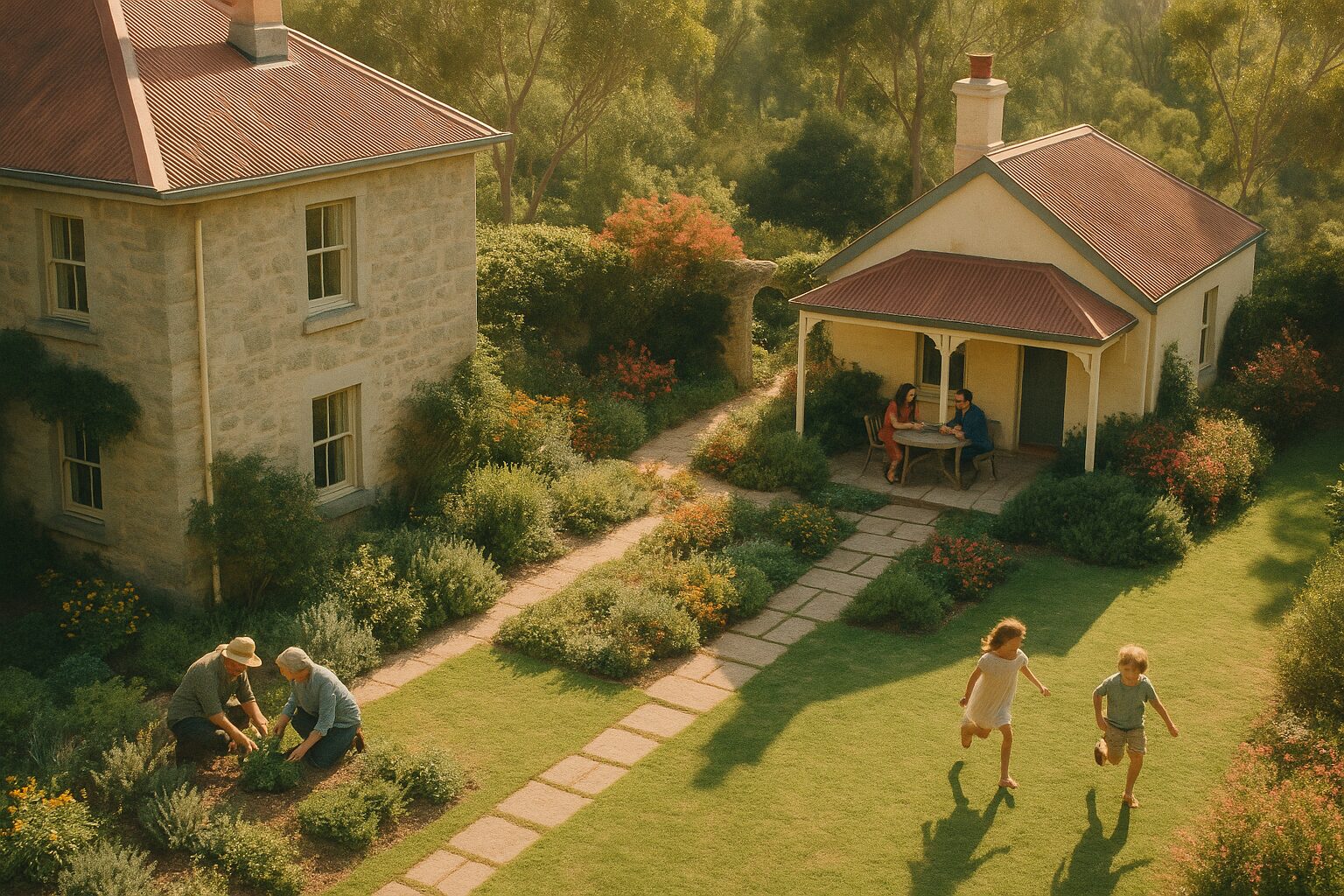
The most successful conversions maintain the grand street presence while positioning additional dwellings within the existing envelope or garden areas. This means grandparents might occupy a converted coach house with its own entrance and garden access, while adult children take a contemporary pavilion positioned behind mature hedging. The original residence remains the property’s centrepiece.
Heritage Victoria prioritises preserving significant views, mature trees and architectural features. Understanding precisely what must remain unchanged versus what can be adapted saves months in the approvals process and prevents costly mid-project redesigns.
- Review your property’s heritage overlay status through the Victorian Planning Schemes database
- Document existing heritage features versus areas with development potential before meeting council planners
Navigating Council and Heritage Requirements
Boroondara and Stonnington councils regularly approve sympathetic multi-dwelling additions that preserve heritage facades and significant gardens. The approval pathway depends heavily on how your proposal demonstrates respect for the existing property while meeting modern living requirements. Council relationships developed over decades matter significantly in these conversations.
Pre-application meetings with council planners can save three to six months by identifying concerns before formal submission. These meetings reveal negotiable versus non-negotiable elements, allowing you to refine your brief before investing in detailed documentation. Fixed-fee architects provide cost certainty through this complex approvals process, which typically takes six to twelve months total.
Heritage consultants engaged early protect your vision while ensuring approval pathways remain realistic. Their assessment distinguishes between elements with genuine heritage significance and those that simply happen to be old. This clarity shapes the entire project direction and prevents expensive surprises during formal assessment.
Permit conditions vary significantly by suburb. Toorak and Canterbury estates face different heritage considerations than Kew or Hawthorn properties. BY Projects Architecture’s 35 years of consistent engagement across Port Phillip, Yarra, Boroondara and Stonnington councils means understanding these distinctions before they become approval obstacles. Teaching roles at RMIT and University of Melbourne inform practical, building-science-backed compliance strategies.
- Schedule a pre-application meeting with your local council’s heritage planner
- Prepare a clear family brief outlining independence needs versus shared spaces
Design Strategies for Toorak and Canterbury Estates
Successful compounds create acoustic separation between dwellings while maintaining visual connection to shared gardens. This balance requires thoughtful positioning of living areas, bedrooms and outdoor spaces so family members enjoy both privacy and connection. Pavilions, coach-house conversions and sympathetic additions each offer different approaches depending on your property’s existing structures.
Converting stables, coach houses or outbuildings preserves the main residence’s grandeur while providing genuinely independent dwellings. Modern services including separate utilities, entrances and garaging maintain independence without disrupting the heritage setting. These conversions often achieve approvals more readily than new construction because they work with existing built form.
Shared amenities become family gathering spaces that justify the compound approach. Pools, tennis courts, entertainment pavilions and expansive gardens offer experiences impossible on separate suburban blocks. These additions receive approval when designed as subordinate structures positioned away from street frontage, maintaining the property’s heritage presentation.
Infrastructure upgrades for power, water and sewerage must be planned early when serving multiple dwellings. Toorak and Canterbury estates often have mature service infrastructure capable of supporting additional capacity. Kew and Hawthorn properties may require more careful service planning to achieve the same outcomes. Quality heritage additions cost $800 to $1,200 per square metre and take 18 to 24 months from concept to completion including approvals.
- Map existing outbuildings and their conversion potential
- Consider sight lines and acoustic privacy between proposed living areas
Creating a multi-generational compound from your heritage property represents sophisticated architectural thinking that serves your family for generations. The expertise demonstrated across 235+ dwellings and complex heritage conversions like the Fairfield church transformation proves that independence and togetherness coexist beautifully within heritage constraints. Your property’s potential awaits the right approach.
For a deeper look, visit https://byarchitecture.com.au/claim-your-free-consultation/
Frequently Asked Questions
Q: Can I add a modern pavilion to my heritage property for adult children?
A: Yes. Contemporary additions are often approved when they are subordinate to the heritage building in scale and prominence, located away from the street frontage, connected via transparent links that don’t obscure the original structure, use quality materials that complement rather than mimic the original, and preserve significant garden views and mature trees. By Projects’ hand-drawn design approach ensures your pavilion vision respects heritage character from the first sketch. Victorian Planning Provisions Clause 43.01 Heritage Overlay guides this approval process, and Boroondara and Stonnington councils actively support quality contemporary work that enhances heritage settings.
Q: How do I know if my architect has the right heritage expertise for a multi-generational compound?
A: Look for demonstrated experience with heritage overlay projects and multi-dwelling conversions—not generic residential work. Your architect should hold relevant credentials (FRAIA or equivalent), maintain established relationships with your local council’s planning and heritage teams, and be able to show completed projects that balance contemporary living with heritage preservation. Fixed-fee structures and transparent timelines signal practitioners who’ve navigated approvals repeatedly and understand the complexity involved.
Q: How long does the entire process take, from initial concept to moving in?
A: Plan for 18–24 months total: 3–6 months for pre-application consultation and concept development, 6–12 months for formal planning approval, and 12–18 months for construction. The timeline varies by council (Boroondara and Stonnington have well-established multi-dwelling pathways) and site complexity—heritage conversions involving structural work or significant infrastructure upgrades typically require longer construction phases. Hand-drawn concept development at the outset prevents costly redesigns later and keeps the overall timeline realistic.
Q: What’s the first step if I want to explore whether my property can become a multi-generational compound?
A: Start by reviewing your property’s heritage overlay status through the Victorian Planning Schemes database and preparing a clear family brief outlining generational independence goals versus shared-space priorities. Schedule a pre-application meeting with your local council’s heritage planner to understand what’s negotiable on your site. An initial consultation with an architect experienced in heritage multi-dwelling conversions will clarify your property’s dwelling yield potential and realistic approval pathways specific to your municipality.
Want to Learn More?
We’ve drawn on decades of experience navigating heritage overlay complexities and building-science principles to create this guide for Melbourne homeowners considering multi-generational compounds. The strategies outlined reflect real approval outcomes across Boroondara, Stonnington, Port Phillip and Yarra, grounded in practical council relationships and residential design expertise.
Citations
- “Victorian Planning Schemes” — The Heritage Overlay (Clause 43.01) sets the framework for what changes are permissible on heritage-protected land. Understanding this provision directly informs feasibility and approval pathways for multi-dwelling conversions. https://www.planning.vic.gov.au/planning-schemes
- “Heritage Overlay Process (Boroondara)” — Boroondara Council’s published guidance explains how heritage consultants, council planners and applicants work together to assess contemporary additions and multi-dwelling proposals on heritage estates. This clarity accelerates pre-application meetings and realistic timeline expectations. https://www.boroondara.vic.gov.au/planning-building/planning-and-heritage/heritage/heritage-overlay-process
- “Victorian Government Changes to Planning” — Recent planning reforms and council-specific multi-dwelling provisions continue to evolve; staying current with official government updates ensures your project aligns with current policy. https://www.boroondara.vic.gov.au/services/planning-and-building/planning/planning-scheme-and-amendments/victorian-government-planning-initiatives/victorian-government-changes-planning
Multi-generational heritage conversions sit at the intersection of two complex disciplines: heritage preservation and multi-residential design. Success requires architects who speak both languages fluently.
If you’d like to explore how BY Projects approaches multi-generational compound design on heritage properties, book a consultation with Barbara Yerondais and the team to discuss your property’s potential.
Your heritage property’s future doesn’t lie in choosing between preservation and growth—it lies in designing both thoughtfully. BY Projects has delivered 235+ dwellings across 59 heritage overlay projects, including complex transformations like the Fairfield church-to-8-dwellings conversion, which demonstrates that even the most constrained heritage sites can accommodate sophisticated multi-generational living when guided by hand-drawn vision, building science rigour, and 35 years of council relationships. Whether your Toorak estate, Canterbury family home or Kew property becomes a private compound depends entirely on asking the right questions early and partnering with architects who’ve solved these puzzles before. The next step is straightforward: understand your site’s constraints, clarify your family’s vision, and let the approvals pathway follow.
96%
Quality Verified
This content scored 96% in the Probably Genius Publication Readiness Assessment, meeting standards for direct answers, section depth, proof points, citation quality, and AI extractability.
By
Mar 04, 2026


Jordan Hughes
23:36 01 May 25

Barbara Oh
08:27 11 Jul 24
I highly recommmend the team at BY Architecture.
Barbara, Howard and the team designed a wonderful extension to my late 1960s Melbourne home, ran the tender process to find me a builder, and superintended the build contract.
The design process that Barbara took me through was comprehensive, well-considered and highly collaborative, and the resulting extension and renovation was incredibly well-tailored to my specific needs and desires.
The tender process was similarly well-run, and we ended up choosing a builder that Barbara had worked with many times before and recommended. The recommendation was a great one and the entire build ran very smoothly, with the many quirks arising in a typical renovation being dealt with intelligently and with no fuss.
During the entire time I worked with them, Barbara and her team went over-and-above to keep me happy. As a result of their attention to detail and their focus on customer service, they ensured that what can often be a stressful time was actually a pleasure. I cannot thank them enough and would work with them again in a heartbeat.
Barbara, Howard and the team designed a wonderful extension to my late 1960s Melbourne home, ran the tender process to find me a builder, and superintended the build contract.
The design process that Barbara took me through was comprehensive, well-considered and highly collaborative, and the resulting extension and renovation was incredibly well-tailored to my specific needs and desires.
The tender process was similarly well-run, and we ended up choosing a builder that Barbara had worked with many times before and recommended. The recommendation was a great one and the entire build ran very smoothly, with the many quirks arising in a typical renovation being dealt with intelligently and with no fuss.
During the entire time I worked with them, Barbara and her team went over-and-above to keep me happy. As a result of their attention to detail and their focus on customer service, they ensured that what can often be a stressful time was actually a pleasure. I cannot thank them enough and would work with them again in a heartbeat.

thir carc
12:44 17 Jun 24
Barbara is very friendly and easy to work with. Thank you for the great advices.
Response from the owner 23:14 17 Jun 24
thank you Arik. Happy to be helpful
Emily Campbell
02:59 31 May 24
Barbara and the BY Projects team were fantastic to work with for our knockdown-rebuild. We had no idea what we were doing or getting ourselves in for, and through every stage of the process Barbara explained everything and was supportive and transparent.
She drew plans for a beautiful house for us which fulfilled everything we wanted while adding such flair and style that we never could have imagined ourselves.
I was so glad to have her and her team on my side throughout the build process, as we would have struggled to advocate for ourselves (or even notice) mistakes or defects by the builder.
Overall, we just couldn’t be happier with the final result.
She drew plans for a beautiful house for us which fulfilled everything we wanted while adding such flair and style that we never could have imagined ourselves.
I was so glad to have her and her team on my side throughout the build process, as we would have struggled to advocate for ourselves (or even notice) mistakes or defects by the builder.
Overall, we just couldn’t be happier with the final result.
Response from the owner 06:53 31 May 24
Thank you for your enthusiasm Emily. And thank you for trusting us with your dream Home. It's been a pleasure working with you and your family, and we trust you will enjoy your home for the years to come.
Jennifer Hauptman
03:43 04 Feb 24

Koray Yazgan
03:49 13 Mar 21
We recently had the pleasure of carrying out a renovation for Barbara and BY Projects Architecture.
The project ran very smoothly from receiving the plans, to handover day.
Barbara pays very close attention to detail and takes great pride in her work.
We look forward to working with BY again on future projects.
The project ran very smoothly from receiving the plans, to handover day.
Barbara pays very close attention to detail and takes great pride in her work.
We look forward to working with BY again on future projects.
Response from the owner 22:11 30 Mar 21
Thank you Koray. It was a pleasure working with AMCON Homes, we look forward to working with you again in the future.
Janardhan S
05:35 15 Feb 21
Barbara provided excellent professional advice regarding Town planning and approval process by the Council. She went out of her way to find the right information and help me. Will surely use their services again when necessary.
I would highly recommend them.
I would highly recommend them.
Response from the owner 01:37 16 Feb 21
Thank you Jarardhan. We do hope you find a more suitable site soon to build your dream homeBarbara
Sophie Banfield
13:34 29 Apr 20
We were in a very difficult position after a VCAT rejection. Barbara came into our project and reimagined what was possible with our property. Going from a house with three shops with significantly reduced value to a development with two town houses, a cafe and all able to be subdivided into three separate properties. Barbara was positive, enthusiastic, charming at planning meeting and all in all kept us positive and hopeful. Barbara went through the whole process with us and I would say went above and beyond what would generally be expected. She worked well with our development team, working out strategies for planning challenges. We are very thankful for her time and energy.

Mark Shannon
23:46 24 Aug 19
We engaged Barbara and her team many times over many years for our Building Development Projects, including Multi Residential, Child Care and Mixed Use. Most recently for a couple of houses in Port Melbourne with complex Heritage Overlay requirements.
Barbara worked with us closely to ensure all design requirements were achieved to exceed market expectations. All permit requirements were managed in a professional and timely manner, and all processes were met on time and on budget.
The finished buildings were outstanding and the realized sales well above market expectations.
We highly recommend BY Projects Architecture for their Design sense and construction experience.
Barbara worked with us closely to ensure all design requirements were achieved to exceed market expectations. All permit requirements were managed in a professional and timely manner, and all processes were met on time and on budget.
The finished buildings were outstanding and the realized sales well above market expectations.
We highly recommend BY Projects Architecture for their Design sense and construction experience.

Virginia Jackson
05:25 24 May 19
I have worked with Barbara and the team at BY Projects on a number of projects now. Its hard to think how you could get better value for money. They are great architects - that goes without saying. But its the extra mile they go to on your behalf in order to secure the very best for you that makes all the difference. I wouldn't hesitate to recommend them for your next project.
Response from the owner 06:02 24 May 19
Thank you Virginia for your kind words. It is always a pleasure working with you.