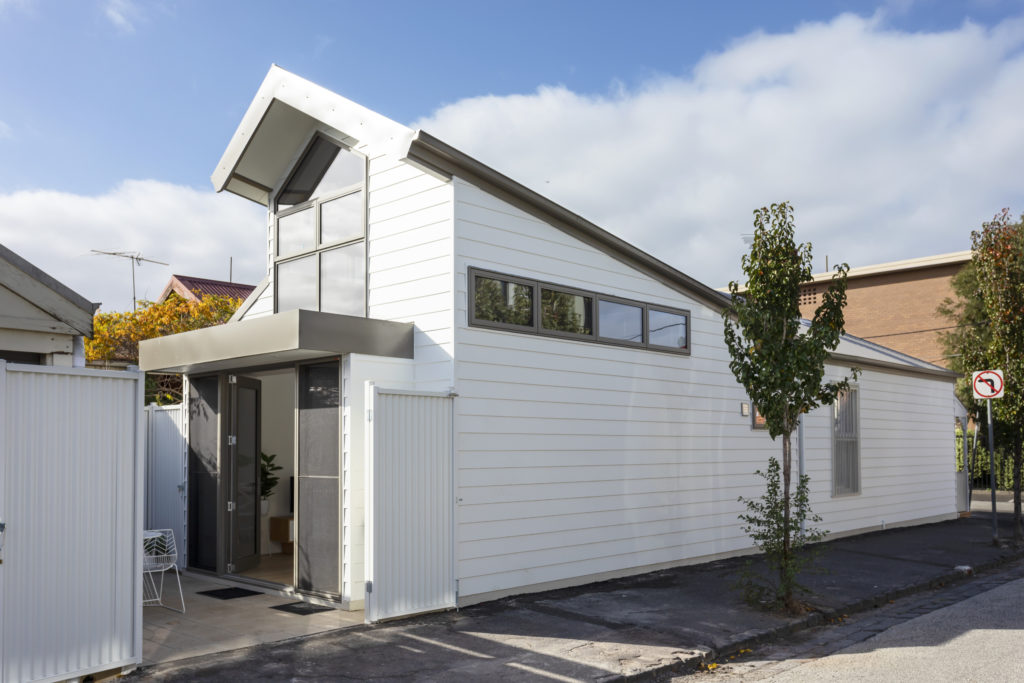
Answering: Can you convert a heritage church or warehouse into homes under a Heritage Overlay in Melbourne?
Estimated reading time: 9 min read
Yes, you can convert a heritage church or warehouse into homes in Melbourne, and adaptive reuse is often the path most likely to win council support. Because the building sits in a Heritage Overlay, you need a planning permit under Clause 43.01 of the planning scheme for the change of use, for external alterations and additions, and for any demolition. The significant fabric, the things that make the building matter, is protected, and a council will not normally approve demolishing it until a replacement is approved. The strategy that works is to keep and celebrate the heritage shell, then insert the new dwellings within and behind it. Across BY Projects Architecture’s adaptive-reuse work, including the Alphington church converted into three dwellings and a Fairfield church reworked into eight, that retain-and-insert approach is what turns a protected building into approved homes.
A redundant church or a solid old warehouse is a rare thing to own: soaring volume, honest materials, a presence no new build can fake. The question is whether you can actually live in it, and what a Heritage Overlay will let you do.
The honest answer is that these are among the most rewarding and most demanding projects in heritage architecture. The constraints are real, but they are navigable, and the buildings reward the effort. Here is how a conversion works under Victoria’s heritage controls, and where the approval is won or lost.
Key Insights
- A heritage church or warehouse conversion needs a planning permit under Clause 43.01 (Heritage Overlay) for the change of use, external works and any demolition.
- Demolition of significant fabric is rarely supported, and a council will not normally approve it until a replacement building is approved.
- Adaptive reuse, retaining the heritage shell and inserting new dwellings within and behind it, is the approach most likely to win approval.
- Residential yield is the design problem: light, services, thermal comfort and privacy all have to be solved without compromising the protected fabric.
| Consideration | Heritage church | Heritage warehouse |
|---|---|---|
| What gives it value | Cathedral volume, timber ceilings, masonry, stained glass | Robust brick or bluestone shell, large floorplate, industrial rhythm |
| Natural light | Often limited; few openings, high windows | Variable; deep floorplate can leave a dark core |
| Typical residential challenge | Subdividing a single tall volume into liveable homes | Bringing light and amenity into a deep plan |
| Where new openings can go | Usually non-heritage roof planes and rear, not principal elevations | Rear and roof, protecting the significant street facade |
| Yield strategy | Insert mezzanines within the volume; additions to rear | Insert floors and courtyards; sympathetic upper additions |
| Permit triggers | Change of use, works, often partial demolition | Change of use, works, often partial demolition |
Keep reading for full details below.
Table of Contents
- What a Heritage Overlay Controls for an Existing Building
- Why Adaptive Reuse Beats Demolition
- Church or Warehouse: The Design Realities
- From Shell to Homes: The Moves That Win Approval
What a Heritage Overlay Controls for an Existing Building
Before you imagine the homes, you need to understand what the planning control actually reaches, because in a Heritage Overlay it reaches almost everything you would want to do.
A church or warehouse you intend to convert is covered by Clause 43.01, the Heritage Overlay, in the local planning scheme. Under that clause a planning permit is generally required to demolish or remove a building, to externally alter a building, to construct a new building or carry out works, and to subdivide land. Converting a former church or warehouse into dwellings almost always triggers several of these at once.
There is a further, often-overlooked trigger: the change of use. A church is not a home, and a warehouse is not a home, so the conversion is a change of use that the planning scheme must consider. Helpfully, the Heritage Overlay contains a provision allowing a permit to be granted to use a heritage place for a purpose that would otherwise be prohibited, where doing so helps secure the building’s long-term conservation. In other words, the system is designed to let a redundant heritage building find a viable new life, exactly what a sensitive residential conversion offers.
What the council weighs, in the words of the overlay’s decision guidelines, is whether the demolition, alteration or new work will adversely affect the significance of the heritage place. That single test, protect the significance, sits behind every decision on your project, and understanding it early is what separates a buildable scheme from a hopeful one.
Why Adaptive Reuse Beats Demolition
The instinct on a difficult old building is sometimes to clear and rebuild. Under a Heritage Overlay, that instinct usually leads to a refusal, and there is a sound design reason to resist it anyway.
As a rule, the demolition or removal of a heritage place, or a significant part of one, will not normally be approved until a replacement building or development has itself been approved. The intent is to stop a significant building being lost on the promise of something better that never arrives. For an owner, the practical consequence is clear: you cannot simply remove the church or the warehouse and decide what to build later. The significant fabric, the principal elevations, the masonry, the roof form, the elements that earned the listing, has to be retained and worked with.
Adaptive reuse turns that constraint into the project’s greatest asset. Rather than fighting the building, you keep the volume and the materials that no new construction could replicate, and you insert contemporary homes that read as a distinct, respectful new layer. Done well, the result is more valuable and more distinctive than a replacement could ever be, and far more likely to be approved. This is the philosophy behind much of our heritage work: navigated well, an overlay does not limit the design so much as give it a reason to be extraordinary.
Church or Warehouse: The Design Realities
Churches and warehouses are both wonderful candidates for conversion, but they hand you very different problems, and recognising which problem you have shapes the whole feasibility.
A church gives you a single, soaring volume, often with beautiful timber ceilings and limited natural light. The design challenge is to carve liveable homes out of that one tall space without destroying the very thing that makes it special. The answer is rarely to slice the volume with full-height walls. More often it is to insert a lighter structure, a “box within a box”, so the original ceiling and proportions stay legible above and around the new rooms. New light is usually found in the non-heritage roof planes and at the rear, where carefully placed skylights and openings do not disturb the significant elevations.
A warehouse gives you the opposite: a generous, robust floorplate, but often a deep plan with a dark core. Here the work is bringing light and amenity inward, frequently through internal courtyards or light wells, and reading the building’s industrial rhythm, its bays and openings, so new floors and dwellings sit with the structure rather than against it. The significant street facade is protected; the moves happen behind and above it.
In both cases, residential yield is the real design problem. How many homes the building will sensibly hold depends on light, services, acoustic separation, thermal comfort and privacy, all resolved without compromising protected fabric. That equation is precisely what a feasibility study should answer before you commit, not after.
From Shell to Homes: The Moves That Win Approval
The difference between a conversion that is approved and one that stalls is usually not ambition; it is the discipline of the design moves and how clearly they answer the heritage test.
Our adaptive-reuse projects follow a consistent logic. On a heritage church in Alphington, inherited after a previous permit had failed, the resolution was a “box within a box”: modern mezzanines inserted into the existing cathedral volume to lift residential yield, new skylights carved only into the non-heritage roof planes, and distinct front and rear additions giving three separate dwellings their own private entries, all while the original timber ceilings and masonry remained the hero. The site carried a sensitive Heritage Overlay and real neighbour objections, and the scheme secured approval for three dwellings where an earlier attempt had not.
A separate church conversion in Fairfield was reworked into eight residential dwellings, a larger-yield example of the same principle: retain and celebrate the significant shell, then add a clearly contemporary residential layer that does not pretend to be old. Across these projects the winning moves are consistent: keep the significant fabric and make it the centrepiece; place new openings and additions where they do not harm the principal elevations; express the new work honestly rather than mimicking the original; and resolve the neighbour and amenity concerns inside the design, before they become objections.
None of that is generic. It comes from having navigated 59 heritage approvals across more than ten Victorian councils, and from treating each building’s significance as the brief rather than the obstacle.
Closing
Converting a heritage church or warehouse into homes is genuinely possible in Melbourne, but it is an adaptive-reuse project from the first line: keep the significant fabric, win the permit for change of use and works under Clause 43.01, and find the homes within and behind the shell rather than in place of it. The buildings are demanding, and they repay it with character no new build can buy. To see how we test a conversion’s feasibility before design begins, visit our process page.
Frequently Asked Questions
Q: Do I need a planning permit to convert a heritage church or warehouse into homes?
A: Yes. Because the building is in a Heritage Overlay (Clause 43.01), you generally need a planning permit for the change of use to residential, for external alterations and additions, and for any demolition, plus a building permit for the construction itself. The change of use is easy to overlook but is a genuine permit trigger, and the overlay specifically allows a permit for an otherwise-prohibited use where it helps conserve the building.
Q: Can I demolish a heritage building and rebuild as apartments?
A: Usually not. Demolition of significant heritage fabric is rarely supported, and a council will not normally approve demolition until a replacement development has been approved. The reliable path is adaptive reuse: retain the significant shell and insert new dwellings within and behind it. That approach is both more likely to be approved and, in our experience, more valuable than a replacement.
Q: How many homes can you fit into a converted church or warehouse?
A: It depends on the building. Residential yield is set by light, services, acoustic and thermal separation and privacy, all resolved without harming protected fabric. Our church conversions have ranged from three dwellings in an Alphington church to eight in a Fairfield church. The right number for your building is a feasibility question best answered before you buy or commit.
Q: What is the most common reason a conversion is refused?
A: Proposing changes that adversely affect the building’s significance, such as new openings in principal elevations, loss of significant fabric, or additions that overwhelm the original form. The council’s central test is whether the work harms the heritage significance. Schemes that retain the significant fabric, place new work sympathetically and answer neighbour concerns in the design are the ones that succeed.
Want to Learn More?
With more than 35 years turning protected buildings into places people live, BY Projects Architecture treats the heritage shell as the starting point of the design, not the limit of it. The most distinctive homes are often the ones a Heritage Overlay made you earn.
Citations
- “Demolition, buildings and works in a Heritage Overlay” — Yarra City Council. Confirms that in an inner-Melbourne Heritage Overlay (Clause 43.01) a planning permit is required to demolish or remove a building, externally alter a building, build an extension or new structure, or carry out works. https://www.yarracity.vic.gov.au/planning-and-building/planning-permits/guides-and-resources/demolition-buildings-and-works-heritage-overlay
- “Heritage overlay” — Yarra City Council. Confirms a Heritage Overlay is a planning control protecting land of heritage significance, meaning a permit is needed to carry out most works, and explains the significant, contributory and not-contributory gradings. https://www.yarracity.vic.gov.au/planning-and-building/heritage/heritage-overlay
- “Permits and approvals” — Heritage Victoria. Confirms that a place may be protected by a Heritage Overlay, the Victorian Heritage Register or the Victorian Heritage Inventory, each with its own permit pathway. https://www.heritage.vic.gov.au/permits-and-approvals
These are the official Victorian sources governing adaptive reuse in a heritage context: Clause 43.01 of the planning scheme for the permit triggers and decision guidelines, and Heritage Victoria for state-level listings.
With 35-plus years and 59 heritage approvals across Melbourne’s councils, our work is to read a protected building honestly, then find the homes it can sensibly hold, so a church or warehouse becomes a place built for living, not just for admiring from the footpath.
92%
Quality Verified
This content scored 92% in the Probably Genius Publication Readiness Assessment, meeting standards for direct answers, section depth, proof points, citation quality, and AI extractability.