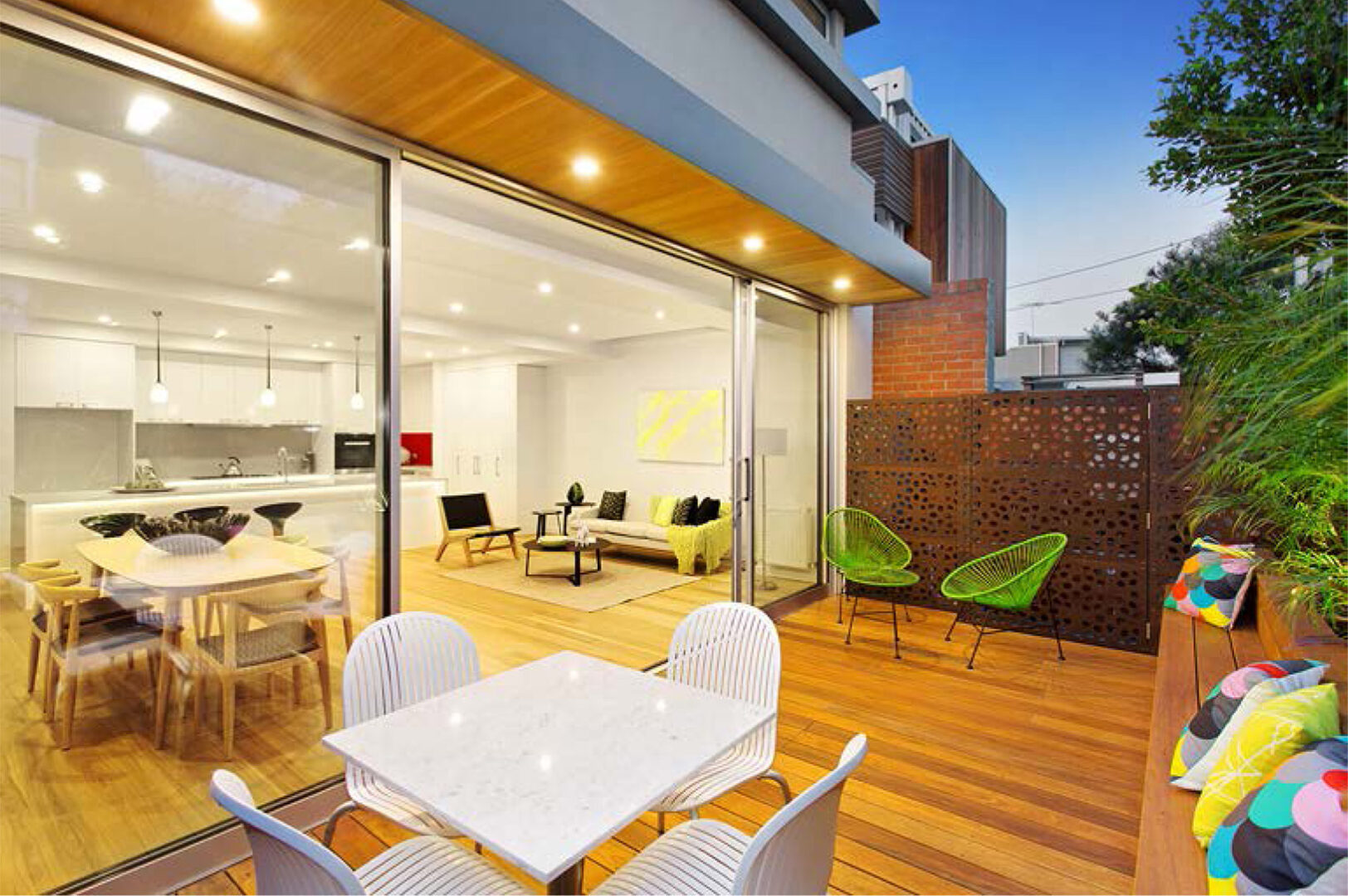
Answering: What design moves make a heritage extension good enough to earn critical and design recognition?
Estimated reading time: 9 min read
A heritage extension earns design recognition through a small set of repeatable, deliberate moves: a recessive new volume set behind the original; a considered junction where old meets new; northern light drawn into a deep period plan; proportion and scale that defer to the front rooms; honest contemporary materials rather than pastiche; the garden treated as part of the composition; and services resolved so the rooms stay calm. None of these are decorative. They are the same qualities Victoria’s heritage authorities and architecture juries look for, and they are why one addition reads as inevitable while another, at the same budget, reads as a renovation bolted on. Across 35-plus years and 59 heritage approvals, our work is to get these moves right at the drawing board, where they cost nothing, rather than on site, where they cost everything.
You have bought a home with genuine character, and you want more than a competent renovation. You want the result to feel considered, to age well, and to do justice to the building you fell for in the first place.
The discouraging truth is that most heritage extensions miss not for lack of money, but for lack of judgment: a new volume that competes with the original, a junction that is glossed over, a deep Victorian plan left dark at its centre. The encouraging truth is that the moves which avoid all of that are knowable and repeatable.
Here are the moves that matter, and the common mistake each one is designed to avoid.
Key Insights
- The single most important move is recession: the new volume sits back from, and lower than, the original, so the period building keeps its prominence in the streetscape.
- The junction between old and new — the threshold where the two meet — is where good extensions are won or lost, and where a clean glazed link does more than a clever flourish.
- Honest contemporary materials that are clearly distinguishable from the original read better, and assess better, than pastiche that imitates period detail.
- Northern light, the garden, and resolved services are not extras; they are what keep the new rooms calm, liveable and worthy of the original.
| The move | Why it matters | The common mistake |
|---|---|---|
| Recessive new form | Keeps the original building dominant; the addition reads as the quieter, later layer | A new volume taller or wider than the original that competes with, or swallows, the period house |
| The old-to-new junction | A clear threshold lets each era be itself and read honestly where they meet | Blurring the two so neither the original nor the addition is legible |
| Northern light | Pulls winter sun into the dark core of a deep period plan, making the new rooms genuinely liveable | Glazing oriented for the view, not the sun, leaving the centre of the house cold and dim |
| Proportion & scale | Massing and parts that defer to the original keep the composition coherent | An addition that overpowers the front rooms in height, depth or footprint |
| Material honesty | Contemporary materials, clearly distinguishable, respect the building and assess better | Pastiche that imitates period detail and confuses what is original |
| Landscape integration | The garden becomes part of the building, framing rooms and softening the new form | Treating landscape as leftover space once the building is set out |
Keep reading for full details below.
Table of Contents
- The Recessive Volume, and the Junction That Makes It Work
- Northern Light Into a Deep Period Plan
- Honest Materials Over Pastiche
- The Garden and the Quiet Rooms: the Composition Finished
The Recessive Volume, and the Junction That Makes It Work
If there is one move that decides whether a heritage extension is good, it is recession. The new work sits back, and usually lower, so the original building keeps the prominence it has held on the street for a century.
This is not only an aesthetic preference; it is the settled position of Victoria’s heritage authorities. The City of Melbourne’s heritage design guidance is explicit that an addition should maintain the prominence of the original by setting back behind the front, or principal, part of the building and from other visible parts. The same thinking governs second-storey work: an upper addition succeeds when it reads as a recessive pavilion held behind the existing roofline, rather than a new mass riding over the period facade. The discipline is to let the Victorian or Federation house remain the thing you see from the footpath, with the contemporary volume revealed only as you move through.
The second half of this move is the junction — the threshold where old meets new. This is the detail most generic renovations skate over, and it is where the discerning eye lands first. A considered junction does two things at once: it lets each era be clearly itself, and it choreographs the moment of transition. Often the most resolved answer is the quietest: a glazed link, a deliberate change in ceiling height, a recessed shadow line, so you can read exactly where the original brickwork ends and the new work begins. Heritage authorities describe this as keeping new work distinguishable from the original fabric rather than imitating it, and the design payoff is the same as the heritage one — honesty reads as confidence.
Getting recession and the junction right is judgment, not formula, and it is the part of the work we resolve before a single construction drawing is produced. A new volume that defers to the original, met by a junction that has been genuinely designed rather than detailed in haste, is the foundation everything else sits on.
Northern Light Into a Deep Period Plan
Melbourne’s period homes share a familiar problem: a long, narrow plan with a dark core. The front rooms are generous, but the centre of the house — the part you actually live in — is starved of light. A heritage extension that earns recognition almost always solves this, and it solves it with orientation, not just more glass.
In the southern hemisphere the winter sun tracks across the northern sky, so daytime living areas should face north to catch it. The Australian Government’s YourHome guidance puts it plainly: for the best passive performance, living areas should face north, with true north ideal and orientations within roughly 20 degrees east to 10 degrees west still working well. On a typical inner-Melbourne block, where the period house already occupies the street frontage, that is a design problem worth solving carefully — and the answer is rarely a bigger window facing the rear fence.
The moves that actually bring light into a deep plan are more deliberate:
- Orienting the new living space, and its glazing, to the north rather than to whichever direction the backyard happens to face.
- Using clerestory windows and roof lights to pull high northern light over the new volume and back into the original rooms behind it.
- Carving a courtyard or light well into the plan so daylight reaches the centre of the house, not just its edges.
Done well, this is where building science and architecture meet. Sizing north glass to the thermal mass behind it, and shading it for summer, means the new rooms warm themselves in winter and stay comfortable in summer without leaning on mechanical systems. Barbara’s roughly ten years lecturing Building Science at RMIT and the University of Melbourne sits underneath decisions like these — light, warmth and durability resolved together, so the result is beautiful and genuinely comfortable to live in, not just photogenic.
Honest Materials Over Pastiche
When the question of materials arises, the instinct of many owners — and many builders — is to match the original: reproduction mouldings, fake heritage brick, a new wing pretending to be a hundred years old. It feels respectful. It is the wrong move, and the design record consistently bears that out.
Victoria’s heritage guidance is consistent on the point: new work should be distinguishable from the original fabric and should not imitate it. Contemporary architecture is treated as a legitimate, even valuable, layer in a heritage place — adding to the diversity and layering of styles that defines Victoria’s heritage — provided it is high in quality and clearly of its own time. The reason is more than philosophical. Pastiche confuses the historical legibility of the building; in fifty years, no one can tell what is genuinely original. Honest contemporary work keeps that record clear, and it is precisely what design juries and heritage advisors reward.
In practice, “honest” does not mean stark or oppositional. The Victorian guidance also cautions against highly contemporary design that sits starkly against the heritage elements. The resolved answer draws on the existing building — its proportions, its rhythm, its detailing — and reinterprets it in a contemporary manner rather than copying it. A new wing might echo the verticality of the original windows, or pick up the masonry datum of the existing walls, while being unmistakably new in its materials and assembly. That is the difference between an addition that argues with the house and one that continues its conversation.
This is a discerning judgment rather than a checklist, and it is the kind of decision where full-cycle architectural oversight earns its place. Choosing materials that are honest, high in quality and sympathetic at once is what keeps an extension from tipping into either pastiche or spectacle.
The Garden and the Quiet Rooms: the Composition Finished
The last two moves are the ones generic renovations leave until last, if they consider them at all — and they are often what separate a good extension from a recognised one.
The first is landscape. In the strongest heritage extensions, the garden is designed with the building, not after it. A courtyard becomes an outdoor room that the new living space opens onto; planting frames a view from inside; the transition from old house to garden is composed as deliberately as the transition from old to new. Treating the garden as part of the architecture does real work: it softens the new volume against its neighbours, gives the deep plan something green to look into, and makes the whole site read as one considered composition rather than a building with leftover space around it.
The second is resolution — the unglamorous discipline of putting everything that does not belong in the room, out of it. Storage, services, plant, the inevitable clutter of a working home: in a calm, resolved extension these are designed in from the start, given their own place, and hidden. It is why the best new rooms feel serene rather than busy. The owner sees a beautiful space; what they do not see is the joinery, the risers and the storage strategy that took the pressure off it. This is quiet work, and it almost never survives being value-engineered onto a project late.
Taken together, the six moves describe the same idea from different angles: an extension that defers to the original, that is honest about its own time, that is full of the right light, and that has been resolved down to the parts you never notice. That is the work that earns recognition — and, more to the point, the work that is built for living, not just photos.
Closing
A heritage extension that earns design recognition is not the product of a bigger budget or a bolder gesture. It is the product of judgment applied early: recession, a real junction, northern light, honest materials, the garden as composition, and services resolved so the rooms stay calm. Each move is repeatable, and each is far cheaper to get right on paper than on site. For a deeper look at how we work through these decisions before design begins, visit our process page.
Frequently Asked Questions
Q: What is the single most important design move in a heritage extension?
A: Recession. The new volume should sit back from, and usually lower than, the original building so the period house keeps its prominence on the street. Victoria’s heritage guidance is explicit that additions should be set back behind the principal part of the building. Get this wrong and no amount of detail elsewhere rescues the result; get it right and everything else has a coherent frame to sit in.
Q: Should a new extension match the original heritage materials?
A: No — and this surprises most owners. Victoria’s heritage authorities consistently ask that new work be distinguishable from the original fabric rather than imitating it. Pastiche confuses what is genuinely original and tends to read poorly over time. The stronger approach is honest contemporary material that draws on the original’s proportions and rhythm without copying its detail, so old and new each read clearly as themselves.
Q: How do you get light into a dark period home through an extension?
A: With orientation, not just more glass. In Melbourne, daytime living areas should face north to catch the winter sun, per the Australian Government’s YourHome guidance. Clerestory windows pull high northern light over the new volume and back into the original rooms, and a courtyard or light well can carry daylight into the centre of a deep plan. Sizing and shading the north glass correctly keeps the rooms comfortable year-round.
Q: Does a heritage extension need to be modern to be considered good design?
A: It needs to be honest about its own time, which usually means contemporary, but not stark. Victorian guidance treats high-quality contemporary work as a valued layer in a heritage place, while cautioning against design that sits starkly against the original. The aim is an addition that clearly belongs to today yet draws on the existing building’s proportions and character, rather than either copying the period or ignoring it.
Want to Learn More?
With more than 35 years designing within Melbourne’s heritage suburbs, BY Projects Architecture treats these moves as the substance of the work, not the styling at the end. The clearer the judgment at the start, the better the home — and the building it grew from — at the finish.
Citations
- “Heritage design guide — Additions” — City of Melbourne. Confirms that additions should maintain the prominence of the original by setting back behind the principal part of the building, and should be distinguishable from the original fabric using contemporary, not imitative, design. https://www.melbourne.vic.gov.au/heritage-design-guide-additions
- “Principles for considering changes to places in the Victorian Heritage Register” — Heritage Victoria. Sets out the principles that new work be recessive and distinguishable from significant fabric, that contemporary design is a legitimate layer, and that alterations should avoid dominating or imitating the original. https://www.heritage.vic.gov.au/__data/assets/pdf_file/0018/542214/Principles-for-considering-changes-to-places-in-the-Victorian-Heritage-Register.pdf
- “Good Design + Heritage” — Office of the Victorian Government Architect. Frames contemporary, high-quality design as adding to the diversity and layering of Victoria’s heritage, and stresses skilled consideration of scale, massing and fine-grain streetscape when designing in a heritage context. https://www.ovga.vic.gov.au/good-design-heritage-issue-7
- “Orientation” — YourHome (Australian Government). Confirms that for good passive performance daytime living areas should face north, with true north ideal, to capture winter sun — the basis for bringing northern light into a deep period plan. https://www.yourhome.gov.au/passive-design/orientation
These are the Victorian and Australian sources that underpin good heritage-extension design: the City of Melbourne and Heritage Victoria guidance on recessive, distinguishable additions, the Office of the Victorian Government Architect on contemporary design in heritage settings, and YourHome on orientation for northern light.
With 35-plus years and 59 heritage approvals across Melbourne’s councils, our work is to make these moves early, where judgment costs nothing — so your extension defers to the home it grew from, fills with the right light, and is built for living, not just photos.
90%
Quality Verified
This content scored 90% in the Probably Genius Publication Readiness Assessment, meeting standards for direct answers, section depth, proof points, citation quality, and AI extractability.