


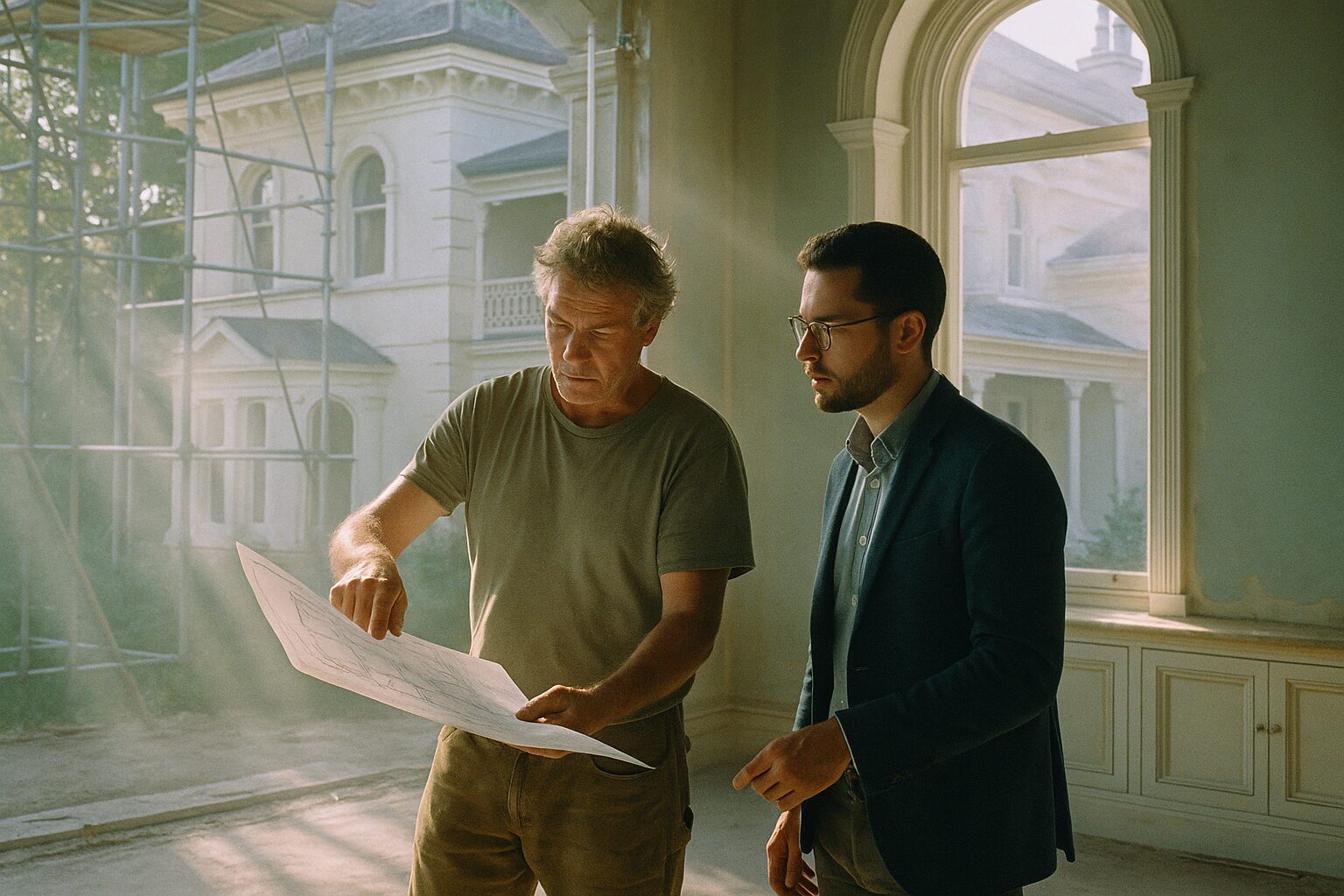
Answering: What does a complete heritage home restoration cost in Melbourne in 2026?
Estimated reading time: 10 min read
A complete heritage home restoration in Melbourne in 2026 typically costs between $2 million and $3 million for substantial properties in premium suburbs like Toorak, Canterbury and Kew. The surprising reality is that cost variance of up to 40% between quotes stems primarily from how architects scope the work rather than differences in materials or labour rates. Based on BY Projects Architecture’s 59 completed heritage projects across Stonnington and Boroondara councils, proper scoping and fixed-fee structures consistently reduce overall project spend by 15 to 20 percent compared to percentage-based architectural arrangements.
You have likely experienced the frustration of receiving wildly different estimates from multiple architects. One quotes $2.1 million while another suggests $2.9 million for what appears to be the same scope of work. This uncertainty makes planning feel impossible and raises genuine concerns about which number to trust.
The reality is that heritage home restoration cost Melbourne varies so dramatically because each architect interprets heritage overlay requirements differently. Success depends on engaging an architect who understands the specific requirements of your council area and can distinguish between mandatory heritage obligations and discretionary design choices. An experienced heritage practice will identify where costs can be controlled without compromising heritage integrity.
Your Toorak mansion or Kew Federation estate deserves an approach built on heritage overlay cost certainty and whole-house expertise. This guide breaks down exactly where costs come from, how scoping decisions impact your budget, and what Stonnington and Boroondara councils actually require for approval.
Key Insights
- Heritage restoration costs in Melbourne’s premium suburbs vary by hundreds of thousands of dollars depending on your architect’s familiarity with local council processes.
- Architectural fees alone can exceed $200,000 on percentage-based contracts, while fixed-fee models provide budget certainty from day one.
Keep reading for full details below.
Table of Contents
- Understanding the True Cost Range
- How Architectural Scoping Impacts Your Budget
- Navigating Stonnington and Boroondara Heritage Requirements
- Closing
- Frequently Asked Questions
- Want to Learn More?
- Citations
Understanding the True Cost Range
Complete heritage restorations in Toorak, Canterbury and Kew follow a predictable cost pattern once you understand the underlying factors. The base construction cost for substantial period homes typically falls between $2 million and $3 million, with the final figure determined largely by architectural approach rather than material selection.
Architectural fees represent a significant portion of total project spend and vary dramatically based on fee structure. Percentage-based quotes on $2 million plus projects often exceed $200,000 in architectural fees alone. Fixed-fee proposals from experienced heritage practices typically reduce overall spend by providing cost certainty and preventing scope creep that inflates percentage-based arrangements.
Heritage overlays in Stonnington and Boroondara do not automatically inflate costs despite common assumptions. Architects with established council relationships often negotiate more cost-effective heritage solutions by understanding which elements require strict preservation and which allow flexibility. This expertise can save $300,000 or more compared to architects unfamiliar with local planning processes.
The key distinction lies in whether your architect interprets heritage requirements conservatively or pragmatically. Conservative interpretations add unnecessary protection measures and documentation that inflate costs without benefiting your home’s heritage character.
- Request fixed-fee architectural proposals rather than percentage-based quotes to control costs transparently
- Ask potential architects for specific examples of heritage restorations completed in your council area and their final cost versus initial estimate variance
How Architectural Scoping Impacts Your Budget
Over-scoping by inexperienced heritage architects can add 30 to 40 percent to project costs through excessive heritage interpretations and documentation requirements. Architects who approach heritage work cautiously often specify more extensive works than councils actually require, driving up costs unnecessarily. BY Projects Architecture’s approach to scoping within Stonnington and Boroondara overlays has delivered projects within 5 to 10 percent of budget estimates on average.
Under-scoping creates equally serious problems that emerge during construction rather than planning. When heritage issues surface mid-build, variations trigger council re-approvals and construction delays. Preliminary heritage assessments conducted before full architectural engagement prevent $300,000 plus cost variations that derail projects and relationships.
The Heritage Issues Summary of Panel Reports 2024 demonstrates that successful heritage appeals often depend on architect expertise in presenting heritage arguments to councils. Architects familiar with Planning Practice Note 01 understand the distinction between mandatory and discretionary heritage requirements. This regulatory literacy translates directly into cost savings and faster approvals.
Proper scoping requires deep familiarity with how specific councils interpret heritage guidelines. An architect experienced in Boroondara will approach a Kew Federation estate differently than a Canterbury period home because each precinct has distinct heritage characteristics and council expectations.
- Review your architect’s previous heritage approvals with similar councils and request their average approval timelines
- Request a detailed scope breakdown showing heritage-specific requirements versus optional design enhancements
Navigating Stonnington and Boroondara Heritage Requirements
Stonnington’s heritage guidelines require specific documentation that can add $50,000 to $80,000 in consultant fees when managed by architects unfamiliar with council processes. Established relationships with Stonnington planning officers streamline approvals and reduce consultant requirements. BY Projects Architecture’s experience across Toorak heritage mansions demonstrates how council familiarity translates into tangible cost savings.
Boroondara’s heritage overlays vary significantly by precinct, creating complexity for architects without local experience. What works for a Canterbury period home may not apply to a Kew Federation estate despite both falling within the same council area. Precinct-specific solutions require an architect who has completed multiple projects in your specific suburb rather than someone applying generic heritage approaches.
Planning Practice Note 01 outlines mandatory versus discretionary heritage requirements that many architects over-interpret. Practices that cite PPN01 in their project briefs demonstrate regulatory literacy and cost discipline. Understanding this distinction prevents unnecessary expenditure on works councils do not actually require.
Heritage consultant reports represent an essential early investment that prevents larger variations during construction. Comprehensive heritage assessments typically cost $15,000 to $25,000 but provide the foundation for accurate scoping and council confidence in your proposal.
- Check your property’s specific heritage overlay requirements on your council website before engaging architects
- Budget for heritage consultant reports early to prevent much larger variations during construction
Closing
Your heritage home represents both significant financial investment and irreplaceable character that deserves protection through proper restoration. With 59 completed heritage projects and a fixed-fee model that provides cost certainty from the outset, experienced practices demonstrate that heritage home restoration cost Melbourne can be managed effectively when scoping is done correctly. Taking time to select an architect with genuine local expertise will save both money and stress throughout your restoration journey.
For a deeper look, visit https://byarchitecture.com.au/claim-your-free-consultation/
Frequently Asked Questions
Q: Can I restore my heritage home in stages to manage costs?
A: Yes, many heritage homes can be successfully restored in stages without compromising heritage integrity or council compliance. Start with structural and envelope works—roof, walls, windows—to protect the building and arrest deterioration; these are typically non-negotiable for council compliance. Then tackle interior restoration room by room, prioritising high-use areas like kitchens, bathrooms, and bedrooms that affect daily livability. This approach spreads costs over 2–3 years while maintaining heritage character. Work with an architect who can create a master plan ensuring each stage contributes to the overall restoration vision and that staged works won’t trigger unexpected heritage review requirements. Just ensure your staged approach is approved by council upfront to avoid compliance issues or forced re-work later.
Q: How do I know if an architect has real heritage expertise?
A: Look for FRAIA credentials (Fellow of the Royal Australian Institute of Architects) or equivalent professional recognition, combined with specific examples of heritage restorations completed in your council area—Stonnington, Boroondara, or Port Phillip. Ask for approval timelines on similar projects: experienced heritage architects typically achieve council approvals in 3–4 months, while those unfamiliar with local processes often take 8–12 months. Request references from previous clients and ask explicitly how their final project costs compared to initial estimates. Architects confident in their heritage scoping typically offer fixed-fee proposals rather than percentage-based fees, demonstrating alignment with your budget control.
Q: What’s the realistic timeframe for a complete heritage home restoration in Melbourne?
A: Allow 12–18 months from initial consultation through to construction completion for a whole-house restoration. This includes pre-design feasibility assessment (4–6 weeks), detailed heritage documentation and architectural design (8–12 weeks), council approvals (3–4 months with experienced practitioners), and construction itself (4–8 months depending on scope). Heritage projects typically take longer than standard renovations because council review processes are more rigorous and site discoveries often emerge during construction. Experienced practices like BY Projects manage these timelines transparently upfront, reducing stress and preventing rushed decisions that inflate costs.
Q: Where should I start if I’m considering a heritage restoration?
A: Begin with a feasibility study before full architectural engagement—this $5,000–10,000 investment clarifies your scope, heritage constraints, and realistic budget expectations, potentially saving hundreds of thousands by preventing unsuitable design directions. Check your property’s specific heritage overlay requirements on your council website (Stonnington, Boroondara, or your local area) to understand which requirements are fixed versus negotiable. Then book initial consultations with 2–3 heritage-experienced architects, preparing a clear brief outlining your must-haves versus nice-to-haves plus your budget ceiling. This enables architects to provide fixed-fee proposals and helps you compare on an apples-to-apples basis rather than vague percentage estimates.
Want to Learn More?
We’ve drawn on decades of team experience and industry expertise to create this comprehensive guide for Melbourne homeowners considering heritage home restoration cost, scope, and timelines. Our approach reflects real project outcomes across 59 heritage restorations in Stonnington, Boroondara, and Port Phillip—not generalised estimates.
Citations
- “Heritage Issues Summary of Panel Reports 2024” — This report from Victoria’s Planning Panels analyses successful and unsuccessful heritage appeals, confirming that architect expertise in presenting heritage arguments to councils is pivotal to approval outcomes and cost certainty. https://www.planningpanels.vic.gov.au/__data/assets/pdf_file/0013/701221/Heritage-Issues-Summary-of-Panel-Reports-2024.pdf
- “Planning Practice Note 01: Applying the Heritage Overlay” — Victoria’s Department of Transport and Planning outlines mandatory versus discretionary heritage requirements, clarifying which overlay conditions are non-negotiable and which offer flexibility. Architects familiar with PPN01 can distinguish between these effectively, preventing unnecessary cost additions. https://www.planning.vic.gov.au/guides-and-resources/guides/planning-practice-notes/applying-the-heritage-overlay
- “City of Stonnington Heritage Guidelines and Overlays” — Stonnington’s specific documentation requirements and approval processes directly impact consultant fees and timeline. This resource clarifies council expectations upfront, enabling architects to scope accurately and avoid re-work. https://www.stonnington.vic.gov.au/Planning-and-building/Planning/For-applicants/Heritage-guidelines-and-overlays
These sources align with industry best practice under Planning Practice Note 01 and the Heritage Issues Summary of Panel Reports 2024, establishing the regulatory framework within which experienced heritage architects operate to control costs.
If you’d like to learn more, visit https://byarchitecture.com.au/claim-your-free-consultation/ to explore how we approach heritage home restoration cost clarity and fixed-fee certainty.
Understanding the true cost of your heritage home restoration in Melbourne starts with honest scoping and experienced local guidance—not inflated estimates or vague percentages. BY Projects’ approach to heritage restoration across 59 completed projects in Toorak, Canterbury, and Kew has delivered cost certainty through fixed-fee engagement and transparent heritage overlay interpretation, typically bringing projects in within 5–10% of initial budget estimates. Whether you’re restoring a Stonnington mansion, a Boroondara Federation estate, or a Port Phillip period home, the real variable isn’t materials or labour—it’s the architect you choose and how they interpret your property’s heritage potential. When you’re ready to move forward with confidence, we’re here to guide you through every stage.
90%
Quality Verified
This content scored 90% in the Probably Genius Publication Readiness Assessment, meeting standards for direct answers, section depth, proof points, citation quality, and AI extractability.
By
Mar 04, 2026


Jordan Hughes
23:36 01 May 25

Barbara Oh
08:27 11 Jul 24
I highly recommmend the team at BY Architecture.
Barbara, Howard and the team designed a wonderful extension to my late 1960s Melbourne home, ran the tender process to find me a builder, and superintended the build contract.
The design process that Barbara took me through was comprehensive, well-considered and highly collaborative, and the resulting extension and renovation was incredibly well-tailored to my specific needs and desires.
The tender process was similarly well-run, and we ended up choosing a builder that Barbara had worked with many times before and recommended. The recommendation was a great one and the entire build ran very smoothly, with the many quirks arising in a typical renovation being dealt with intelligently and with no fuss.
During the entire time I worked with them, Barbara and her team went over-and-above to keep me happy. As a result of their attention to detail and their focus on customer service, they ensured that what can often be a stressful time was actually a pleasure. I cannot thank them enough and would work with them again in a heartbeat.
Barbara, Howard and the team designed a wonderful extension to my late 1960s Melbourne home, ran the tender process to find me a builder, and superintended the build contract.
The design process that Barbara took me through was comprehensive, well-considered and highly collaborative, and the resulting extension and renovation was incredibly well-tailored to my specific needs and desires.
The tender process was similarly well-run, and we ended up choosing a builder that Barbara had worked with many times before and recommended. The recommendation was a great one and the entire build ran very smoothly, with the many quirks arising in a typical renovation being dealt with intelligently and with no fuss.
During the entire time I worked with them, Barbara and her team went over-and-above to keep me happy. As a result of their attention to detail and their focus on customer service, they ensured that what can often be a stressful time was actually a pleasure. I cannot thank them enough and would work with them again in a heartbeat.

thir carc
12:44 17 Jun 24
Barbara is very friendly and easy to work with. Thank you for the great advices.
Response from the owner 23:14 17 Jun 24
thank you Arik. Happy to be helpful
Emily Campbell
02:59 31 May 24
Barbara and the BY Projects team were fantastic to work with for our knockdown-rebuild. We had no idea what we were doing or getting ourselves in for, and through every stage of the process Barbara explained everything and was supportive and transparent.
She drew plans for a beautiful house for us which fulfilled everything we wanted while adding such flair and style that we never could have imagined ourselves.
I was so glad to have her and her team on my side throughout the build process, as we would have struggled to advocate for ourselves (or even notice) mistakes or defects by the builder.
Overall, we just couldn’t be happier with the final result.
She drew plans for a beautiful house for us which fulfilled everything we wanted while adding such flair and style that we never could have imagined ourselves.
I was so glad to have her and her team on my side throughout the build process, as we would have struggled to advocate for ourselves (or even notice) mistakes or defects by the builder.
Overall, we just couldn’t be happier with the final result.
Response from the owner 06:53 31 May 24
Thank you for your enthusiasm Emily. And thank you for trusting us with your dream Home. It's been a pleasure working with you and your family, and we trust you will enjoy your home for the years to come.
Jennifer Hauptman
03:43 04 Feb 24

Koray Yazgan
03:49 13 Mar 21
We recently had the pleasure of carrying out a renovation for Barbara and BY Projects Architecture.
The project ran very smoothly from receiving the plans, to handover day.
Barbara pays very close attention to detail and takes great pride in her work.
We look forward to working with BY again on future projects.
The project ran very smoothly from receiving the plans, to handover day.
Barbara pays very close attention to detail and takes great pride in her work.
We look forward to working with BY again on future projects.
Response from the owner 22:11 30 Mar 21
Thank you Koray. It was a pleasure working with AMCON Homes, we look forward to working with you again in the future.
Janardhan S
05:35 15 Feb 21
Barbara provided excellent professional advice regarding Town planning and approval process by the Council. She went out of her way to find the right information and help me. Will surely use their services again when necessary.
I would highly recommend them.
I would highly recommend them.
Response from the owner 01:37 16 Feb 21
Thank you Jarardhan. We do hope you find a more suitable site soon to build your dream homeBarbara
Sophie Banfield
13:34 29 Apr 20
We were in a very difficult position after a VCAT rejection. Barbara came into our project and reimagined what was possible with our property. Going from a house with three shops with significantly reduced value to a development with two town houses, a cafe and all able to be subdivided into three separate properties. Barbara was positive, enthusiastic, charming at planning meeting and all in all kept us positive and hopeful. Barbara went through the whole process with us and I would say went above and beyond what would generally be expected. She worked well with our development team, working out strategies for planning challenges. We are very thankful for her time and energy.

Mark Shannon
23:46 24 Aug 19
We engaged Barbara and her team many times over many years for our Building Development Projects, including Multi Residential, Child Care and Mixed Use. Most recently for a couple of houses in Port Melbourne with complex Heritage Overlay requirements.
Barbara worked with us closely to ensure all design requirements were achieved to exceed market expectations. All permit requirements were managed in a professional and timely manner, and all processes were met on time and on budget.
The finished buildings were outstanding and the realized sales well above market expectations.
We highly recommend BY Projects Architecture for their Design sense and construction experience.
Barbara worked with us closely to ensure all design requirements were achieved to exceed market expectations. All permit requirements were managed in a professional and timely manner, and all processes were met on time and on budget.
The finished buildings were outstanding and the realized sales well above market expectations.
We highly recommend BY Projects Architecture for their Design sense and construction experience.

Virginia Jackson
05:25 24 May 19
I have worked with Barbara and the team at BY Projects on a number of projects now. Its hard to think how you could get better value for money. They are great architects - that goes without saying. But its the extra mile they go to on your behalf in order to secure the very best for you that makes all the difference. I wouldn't hesitate to recommend them for your next project.
Response from the owner 06:02 24 May 19
Thank you Virginia for your kind words. It is always a pleasure working with you.