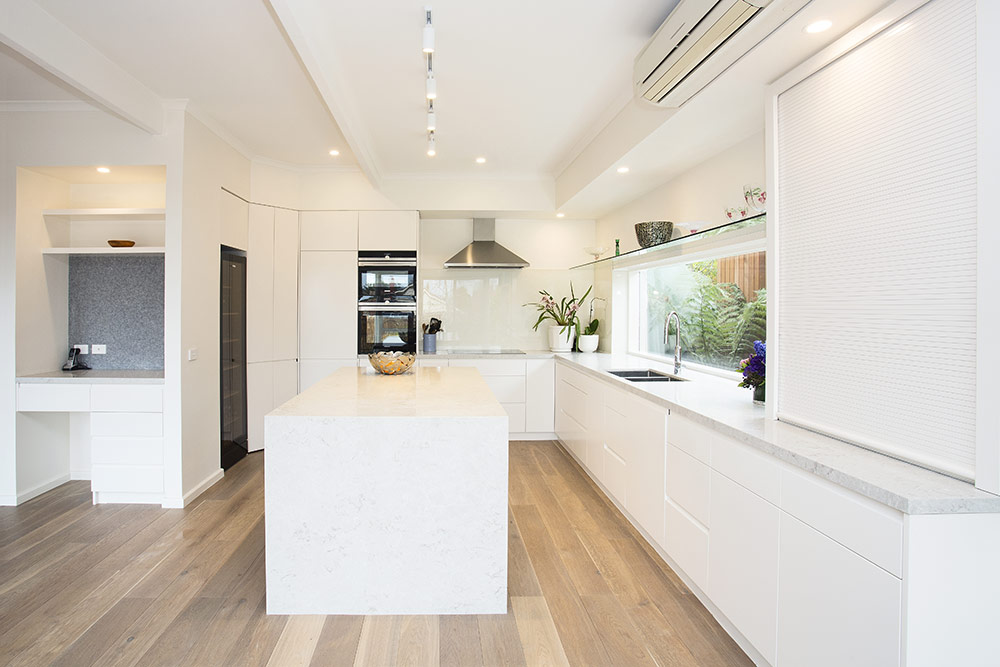
Answering: How do you add a contemporary luxury wing to a Victorian villa without losing its heritage character?
Estimated reading time: 9 min read
The way to extend a Victorian villa without losing its character is to read what is genuinely significant first, protect it, and then place the contemporary luxury living at the rear, where a Heritage Overlay generally gives you room to be modern. The original front facade, verandah and principal rooms are the heritage story, so they are restored, not reinvented. The new wing reads honestly as new work, distinct from the old rather than a copy of it, and connected through a clear transition. Across more than 59 heritage approvals in Melbourne, that sequence, significance first, contemporary work second and to the rear, is what lets an affluent inner-east home gain a genuinely modern living space and keep the period soul that made it worth buying.
You bought the villa for its presence: the cast-iron verandah, the deep hallway, the proportions you cannot build today. What you want now is light, openness and a kitchen and living space that work for how your family actually lives. The two ambitions can feel as though they pull against each other.
They do not have to. Handled well, the period front and the contemporary rear each do what they do best, and the junction between them becomes the most considered part of the house.
This is the conversation we work through before a single line is drawn. Here is how the old and the new are reconciled on a heritage villa.
Key Insights
- The heritage value of a Victorian villa sits mostly in the front facade, verandah and principal rooms, which is where a Heritage Overlay (Clause 43.01) protects most strongly.
- Contemporary luxury work belongs at the rear, where it can be secondary, recessive and largely hidden from the street.
- Heritage Victoria guidance favours new work that is clearly distinguishable from the original, not a pastiche copy of period detail.
- The transition between old and new, often a recessive link, is where the design is won or lost.
| Period element | Approach | Design reasoning |
|---|---|---|
| Front facade & verandah (cast iron, parapet, return) | Restore | The primary heritage value and streetscape contribution; conserve and repair original fabric, reinstate missing detail accurately. |
| Original front rooms | Keep | Retain proportion, ceiling height, joinery and fireplaces; reuse as bedrooms, study or formal sitting, with services upgraded discreetly. |
| Central hallway | Keep & reinterpret | Preserve as the spine; let it run through to the new wing so the transition from old to new is read as you move. |
| Rear lean-to / service wing | Reinterpret | Usually later, lower-value fabric; the logical place to remove and replace with the contemporary living wing. |
| Garden & orientation | Reinterpret | Open the new wing north and to the garden for light the deep period plan never had. |
Keep reading for full details below.
Table of Contents
- Reading What Is Actually Significant in a Victorian Villa
- Where the Heritage Overlay Lets Contemporary Work Go
- The Junction Between Old and New
- Light, Orientation and Material Honesty
Reading What Is Actually Significant in a Victorian Villa
Before you decide what to change, you have to be honest about what carries the heritage value, because not every part of a Victorian villa is equally significant.
Heritage Victoria’s own guide to identifying period homes points to the elements that define the Victorian era: the symmetrical or asymmetrical front, the cast-iron lacework to the verandah, the ornamented parapet, decorative chimneys and the generous single-storey proportions. These are the features that read from the street and tell you the building’s age and story. On most inner-east villas, the heritage significance is concentrated in the principal facade, the verandah and its detail, the return down the prominent side, and the original front rooms behind them.
What is usually not significant is just as important to identify. The rear of a Victorian villa was rarely designed to be seen. Over a century it typically accumulated lean-to additions, a tacked-on kitchen, a closed-in verandah, an outdoor laundry, fabric that is often later, lower in quality, and not what the overlay is protecting.
This reading is the whole foundation of a good outcome:
- The facade, verandah and front rooms are conserved and restored.
- The later rear fabric becomes the site for the new living wing.
- The Statement of Significance for the place, where one exists, tells you which of these the council values and why.
Across more than ten Victorian councils, including Boroondara, Stonnington, Yarra and Port Phillip, our first task on a villa is this honest read, separating the period heart that must be kept from the later fabric that gives you room to move.
Where the Heritage Overlay Lets Contemporary Work Go
A Heritage Overlay does not forbid contemporary work. It shapes where that work can go and how visible it can be.
The overlay, Clause 43.01 of your council’s planning scheme, applies because the place has been identified as having cultural heritage significance, and it generally requires a planning permit for external buildings and works, demolition and alterations. The control is not anti-modern. Read alongside council heritage design guidance, it consistently steers substantial new work to the same place: the rear, where it can be secondary to the original building and have little or no effect on the streetscape.
In practice, for a single-storey Victorian villa in a prestige suburb, that means a contemporary wing that:
- Sits behind the original building, set back from the principal facade so the period front still reads as the dominant form from the street.
- Stays subservient in scale, so it does not overwhelm or compete with the villa.
- If a second storey is contemplated, is recessed and set well back, so it is concealed or barely glimpsed behind the existing roof ridge.
Councils such as Stonnington, through their published heritage design guidelines, are explicit that additions should be visually recessive and respect the scale of the original. That is a constraint, but it is also a gift: it concentrates your budget and your design ambition exactly where contemporary luxury belongs, at the rear, opening to the garden, rather than fighting the heritage front.
This is where reading the overlay correctly at the outset pays for itself. A scheme designed to the constraint, rather than against it, is the one that clears the planning permit cleanly and lets the build proceed.
The Junction Between Old and New
Once you know the front is kept and the rear is contemporary, the design question becomes the most interesting one in the whole project: how the two meet.
The junction is rarely a blunt collision of old wall and new wall. On a considered villa extension it is usually a deliberate transition, often a recessive glazed link, a lower or narrower connector that lets the original building end and the new wing begin as two clearly separate things. That break does real work. It signals respect for the original fabric, it gives the new work permission to be its own architecture, and it satisfies the council’s expectation that the heritage form remains legible.
The central hallway is the device that makes the transition feel inevitable rather than awkward. On most Victorian villas the hall is the spine of the plan, and the best extensions let it continue, drawing you from the formal, contained, high-ceilinged front through the link and into the open, light-filled rear. You experience the history first, then the contemporary release, in one connected sequence.
Getting that junction right is detailed work: floor levels that were never meant to align, the meeting of original masonry with new structure, the point where period plaster gives way to a modern ceiling. Across more than 200 permit applications, much of the craft is in resolving exactly these transitions, so the home reads as one considered piece, built for living, not just photos, rather than two houses bolted together.
Light, Orientation and Material Honesty
The reason to put the contemporary work at the rear is not only heritage compliance. It is where you can finally fix what a deep Victorian plan never gave you: light.
A Victorian villa is typically a long, deep plan with rooms strung off a central hall, generous in height but often dim through the middle. The rear is where you can reorient the home toward the north and the garden, bring in the daylight, cross-ventilation and connection to outdoor space the original layout could not offer. This is also where building-science thinking earns its place, glazing oriented for warmth in winter and shaded in summer, insulation and thermal mass that make the new wing genuinely comfortable, not just open. Barbara’s years lecturing Building Science at RMIT and the University of Melbourne sit behind these decisions.
Material honesty is the principle that ties the whole approach together. Heritage Victoria’s guidance on heritage impact is clear that new work should be distinguishable from the old, and it warns specifically against the incorrect use of traditional details, adding features that never existed, or copying period ornament onto new construction. So the contemporary wing should read as contemporary:
- New materials, expressed honestly, that complement the villa’s brick or render without imitating its mouldings and lacework.
- Clean, modern detailing at the rear, with the period detail restored, not replicated.
- A clear visual hierarchy, so a visitor can always tell which part of the house is 1880 and which is today.
That honesty is what separates a confident heritage extension from a costume. The villa keeps its authentic period character precisely because the new work does not pretend to be old, and the contemporary luxury living reads as a genuine, well-resolved addition to a home with real history.
Closing
Extending a Victorian villa well is not a compromise between heritage and luxury. It is a sequence: read what is significant, restore the period front, place the contemporary living wing at the rear where the Heritage Overlay allows it, resolve the junction with care, and let the new work be honestly new. Done this way, the home gains the light and openness affluent owners want and keeps the character they bought it for. For a closer look at how we work through this before design begins, visit our process page.
Frequently Asked Questions
Q: Can I add a modern extension to a Victorian villa in a Heritage Overlay?
A: In most cases, yes. A Heritage Overlay (Clause 43.01) does not prohibit contemporary work; it requires a planning permit and steers substantial new work to the rear, where it can be secondary and largely hidden from the street. Council guidance generally supports a modern living wing behind the original villa, provided the period facade, verandah and front rooms are conserved and the addition stays recessive in scale.
Q: Should a heritage extension match the old house or look different?
A: Heritage Victoria’s guidance favours new work that is clearly distinguishable from the original rather than a copy of period detail. It cautions against adding features that never existed or imitating traditional ornament on new construction. The accepted approach is to restore the period elements accurately and let the contemporary wing read honestly as new, so a visitor can always tell which part of the home is original.
Q: Which parts of a Victorian villa have to be kept?
A: The heritage value usually sits in the principal facade, the cast-iron verandah and its detail, the parapet, decorative chimneys and the original front rooms, the elements that read from the street. Later rear fabric, such as lean-to additions or a tacked-on kitchen, is often lower in value and is typically where a new wing can go. The place’s Statement of Significance, where one exists, confirms what the council values.
Q: Where is the best place to add contemporary living space to a period home?
A: The rear. It is where the Heritage Overlay generally allows substantial new work, where you can reorient the home to the north and garden for the light a deep Victorian plan lacks, and where a recessive transition can connect the old and new. Concentrating the contemporary luxury at the rear keeps the heritage front intact and gives the living space the openness modern owners want.
Want to Learn More?
With more than 35 years designing within Melbourne’s heritage suburbs, BY Projects Architecture treats the meeting of period character and contemporary living as the heart of the design, not an afterthought. Read the villa honestly, and the new wing almost designs itself.
Citations
- “Demolition, buildings and works in a Heritage Overlay” — Yarra City Council. Confirms that under Clause 43.01 a planning permit is generally required to demolish or remove, externally alter, extend or construct a building on land in a Heritage Overlay. https://www.yarracity.vic.gov.au/planning-and-building/planning-permits/guides-and-resources/demolition-buildings-and-works-heritage-overlay
- “What house is that?” — Heritage Victoria. Sets out the defining features of Victorian-era houses, including the cast-iron verandah lacework, ornamented parapets, decorative chimneys and period proportions that carry the streetscape value. https://www.heritage.vic.gov.au/__data/assets/pdf_file/0020/505235/What-house-is-that.pdf
- “Guidelines for preparing heritage impact statements” — Heritage Victoria. Advises that new work should be distinguishable from the original and warns against the incorrect use of traditional details or adding features that never existed, the basis for material honesty. https://www.heritage.vic.gov.au/__data/assets/pdf_file/0023/507047/Guidelines-for-preparing-heritage-impact-statements-June-2021.pdf
- “Heritage Design Guidelines 2017” — City of Stonnington. Sets out council expectations for additions to heritage places in a prestige inner-east municipality, including that new work be visually recessive, set back and respect the scale of the original. https://www.stonnington.vic.gov.au/files/assets/public/v/1/business/heritage-design-guidelines-2017.pdf
These are the official Victorian sources that govern extending a heritage home: the Heritage Overlay provisions of the planning scheme, Heritage Victoria’s guidance on period-home character and heritage impact, and council heritage design guidelines for the inner-east.
With 35-plus years and more than 59 heritage approvals across Melbourne’s councils, our work is to reconcile a Victorian villa’s period character with the contemporary luxury you want to live in, so the home keeps its soul and finally gains its light.
92%
Quality Verified
This content scored 92% in the Probably Genius Publication Readiness Assessment, meeting standards for direct answers, section depth, proof points, citation quality, and AI extractability.