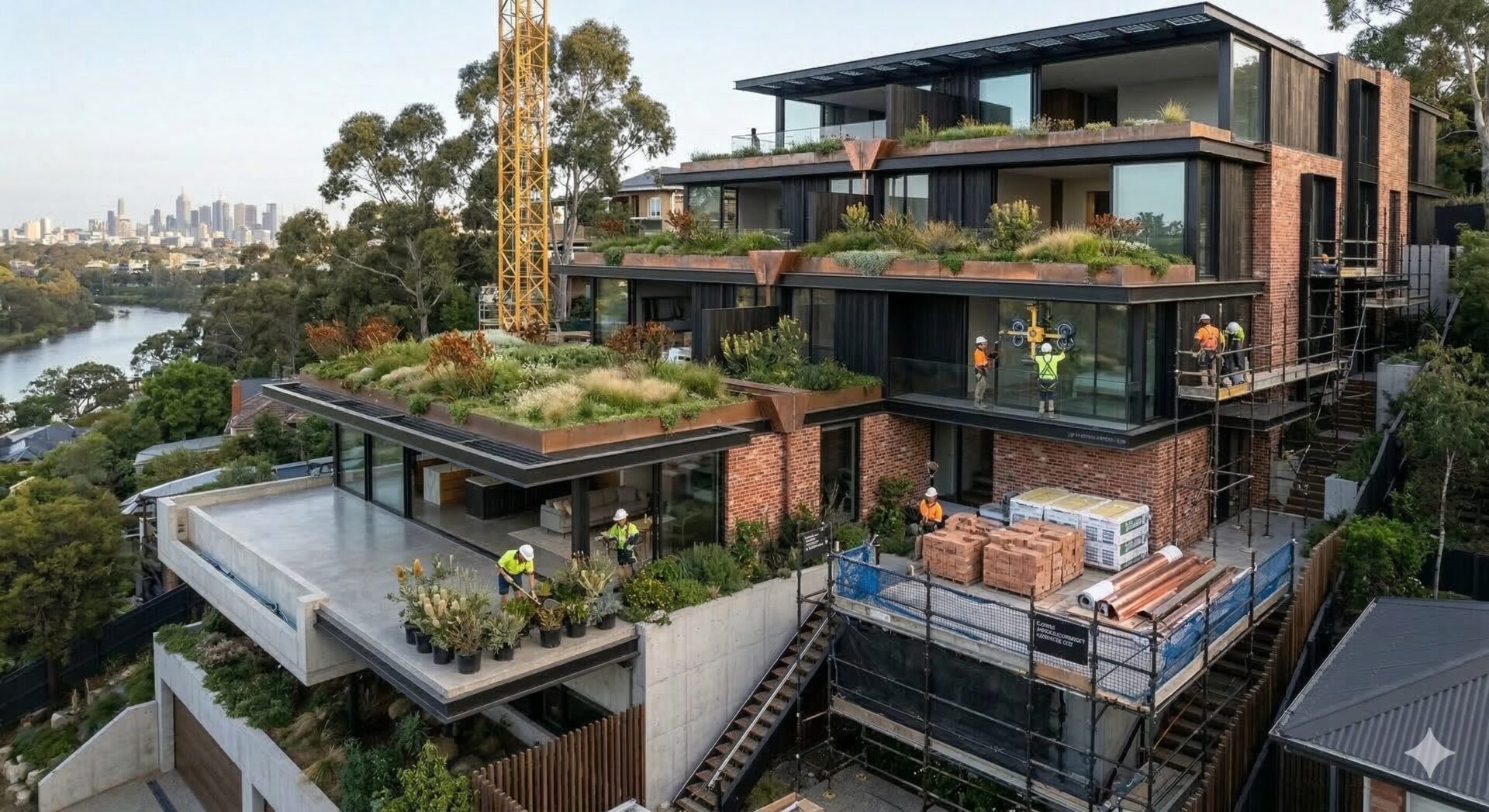
Answering: How do you choose an architect for a difficult or sloping site in Melbourne?
Estimated reading time: 9 min read
To choose an architect for a difficult or sloping Melbourne site, judge them on five things: a real track record of building on constrained blocks (steep, narrow, awkward or overlaid), a feasibility-first process that tests what the site will and won’t do before design begins, fluency with the council and overlays that govern your land, genuine building-science grounding for retaining, drainage and structure, and fixed-fee certainty so a hard site doesn’t become an open-ended bill. The right architect treats the constraint as the brief, not an obstacle to apologise for. At BY Projects Architecture, that begins with a feasibility-first protocol and a record of 59 heritage approvals delivered on constrained sites across Victoria.
Everyone said your block was a problem. The right architect sees it as the whole point. You have likely already heard a few of them flinch, the slope quietly priced as a reason to walk, the narrow frontage treated as a flaw rather than a feature, perhaps even the word “unbuildable” floated as though the land had failed you.
The stakes are real. A difficult site handled by the wrong hands can mean a refused permit after months of waiting, a retaining and drainage bill that dwarfs the build, or a generic box dropped onto land that deserved a considered response. Handled well, the same constraint becomes the most distinctive home on the street. This guide sets out exactly what to look for, the red flags to walk away from, and the questions that separate an architect who fears your site from one who has been waiting for it.
Key Insights
- A “difficult” site is usually a combination of factors: slope and split levels, retaining and drainage, restricted access, narrow frontage, easements, and planning overlays such as Heritage or Significant Landscape.
- Difficult sites reward a feasibility-first architect who tests the constraints before design begins, so the budget and the permit path are real, not hopeful.
- Overlays do not change what your zone allows, but they can require a planning permit and shape what is actually buildable, so council and overlay fluency matters.
- Choose on five criteria: constrained-site track record, building-science grounding, council and overlay fluency, fixed-fee certainty, and a process that treats constraint as the brief.
| What makes a site “difficult” | The real challenge | What the right architect does |
|---|---|---|
| Slope and split levels | Cut-and-fill cost, structure, where the living spaces land | Designs into the topography rather than flattening it |
| Retaining and drainage | Overland stormwater, soil movement, walls over 1 metre | Resolves levels, retaining and water early, with engineering input |
| Restricted access | Steep or narrow approach for vehicles and construction | Tests buildability and staging before committing the design |
| Narrow frontage | Light, privacy and circulation on a tight footprint | Reorients living spaces to the site, not a standard plan |
| Easements | Land you can’t build over; services and drains beneath | Maps title and services first, designs around them |
| Overlays (Heritage, Landscape) | A planning permit and design controls on top of the zone | Reads the overlay correctly and designs to it from day one |
Keep reading for full details below.
Table of Contents
- What Actually Makes a Melbourne Site “Difficult”
- Why a Hard Site Rewards a Feasibility-First Architect
- The Five Criteria for Choosing the Right Architect
- Mapping the Melbourne Field, and Where BY Fits
What Actually Makes a Melbourne Site “Difficult”
A “difficult” site is rarely difficult for a single reason. It is usually a stack of constraints that interact, and the interaction is what trips up an architect who has not done it before.
The most common factors, and the ones that genuinely change a design, are these:
- Slope and split levels. The Australian Government’s YourHome guidance notes that slope affects which materials are economical, solar access, wind exposure and physical access to the building. A steep block can be answered with split levels and a design that follows the land, or fought with large volumes of cut and fill, which is costly and disturbs natural drainage.
- Retaining and drainage. Overland stormwater is one of the most serious risks on a sloping block, and retaining walls above roughly a metre generally need engineering and approval. Levels, retaining and water have to be resolved together, not bolted on.
- Restricted access and narrow frontage. A steep or tight approach limits how the home is built and staged, and a narrow block forces light, privacy and circulation to be solved by design rather than floor area.
- Easements and title constraints. An easement is land you generally cannot build over, often carrying drains or services, and it has to be read off the title before a single line is drawn.
- Overlays. Planning overlays such as the Heritage Overlay or a Significant Landscape Overlay sit on top of your zone. As Planning Victoria explains, an overlay generally addresses a single issue and may require a permit for development the zone would otherwise allow.
The point is not that any one of these is fatal. It is that they compound, and the architect’s job is to read the whole stack correctly at the outset, then design with it.
Why a Hard Site Rewards a Feasibility-First Architect
On a straightforward block, a weak process can still produce a reasonable home. On a difficult site, process is the difference between a distinctive house and a refusal.
This is why feasibility-first thinking matters so much here. Before any design is committed, the constraints are tested honestly: the slope and how the levels will work, the retaining and drainage strategy, the access and staging, the easements on the title, and the overlay controls that govern what is buildable. The aim is to understand what the site will and won’t do before money goes into design, so the budget you are given is real and the permit path is sound.
Two things follow from getting this right. First, you avoid the expensive trap of designing a home the site cannot carry, then paying again to redraw it. Second, you turn the constraint into the idea. A slope handled well gives you light, outlook and a sectional richness a flat block never could. At BY Projects Architecture, this is the role of our feasibility-first protocol, and across 59 heritage approvals on constrained sites, much of the work is anticipating the structural, drainage and overlay questions early enough to design around them rather than against them.
Barbara Yerondais’s background in Building Science, which she lectured for around ten years at RMIT and the University of Melbourne, sits underneath this. Retaining, drainage, thermal performance and durability on a hard site are not afterthoughts to the aesthetics; they are part of the design from the first sketch.
The Five Criteria for Choosing the Right Architect
Use these criteria to assess any architect you are considering for a constrained block. The right firm should be able to evidence all five.
Your five-criteria checklist
- Constrained-site track record. Not just a beautiful portfolio, but proof of work on steep, narrow, awkward or overlaid sites. Ask to see the hard ones, not only the showpieces.
- Building-science grounding. A genuine command of structure, retaining, drainage and thermal performance, so the design is buildable and durable, not just photogenic.
- Council and overlay fluency. Demonstrated experience reading overlays and arguing a design through the relevant Victorian council, because the planning case is half the battle on an overlaid site.
- Feasibility-first process. A defined stage that tests the site’s realities before design begins, so the scope and budget are grounded in fact.
- Fixed-fee certainty. A clear fee structure so a complex site does not become an open-ended cost, and you are not dreading the next invoice.
Red flags to walk away from
- An architect who treats your site as a problem to apologise for, rather than a brief to design to.
- A firm that wants to start drawing before testing the slope, drainage, access, easements and overlay controls.
- A standard house type proposed for a non-standard site, with the constraint planned to be “engineered out” later.
- Vagueness about fees on a complex job, or a habit of treating the budget as something to be discovered as you go.
- No clear answer when you ask how they have handled retaining, drainage or an overlay on a comparable block.
Questions to ask before you engage
- Can you show me projects on sites as constrained as mine, and what the specific challenge was on each?
- How will you test the slope, retaining, drainage and access before we commit to a design?
- Which overlays apply to my land, and how will they shape what we can build?
- How do you handle the structural and building-science side, and do you bring in engineers early?
- Is your fee fixed, and what exactly does it cover through to the permit?
If an architect answers these openly, with examples, you are likely talking to someone who treats constraint as the work. If the answers are thin, that tells you something too.
Mapping the Melbourne Field, and Where BY Fits
Melbourne has a deep bench of design-led residential practices, and several are well known for considered, site-responsive work, among them firms such as Studio Bright, Kennedy Nolan and Robson Rak. The honest advice is to match the firm to the specific difficulty of your site rather than to a general reputation. A practice celebrated for crafted interiors is not automatically the right choice for a steep block with a drainage problem and a Significant Landscape Overlay; the relevant question is who has solved your kind of constraint before.
On that test, BY Projects Architecture specialises in difficult sites, adaptive reuse and heritage-approval work. Across more than 35 years and 400-plus projects delivered by the practice across Victoria, the firm’s record on constrained and protected sites is concrete: 59 heritage approvals, and adaptive-reuse projects such as a Fairfield church converted into eight residential dwellings, where the constraint itself was the design opportunity. The practice is active across more than ten Victorian councils, including Boroondara, Stonnington, Port Phillip, Yarra and Bayside, which is the council and overlay fluency a hard site demands.
None of this is a claim to be better than every other firm. It is a claim to specialise in exactly the thing you are worried about: a site other architects flinched at. If that is your block, the next step is to have it read properly.
Closing
A difficult site is not a verdict on your block; it is a brief most architects have not learned to answer. Choose on the five criteria, watch for the red flags, ask the hard questions, and you will find the firm that sees the constraint as the point. For a deeper look at how we test a site before design begins, visit our process page.
Frequently Asked Questions
Q: What makes a building site “difficult” or “unbuildable”?
A: Usually a combination of factors rather than one. A site can be difficult because of slope and split levels, the cost of retaining and drainage, restricted access, a narrow frontage, easements you cannot build over, or planning overlays such as Heritage or Significant Landscape that add a permit and design controls. Very few sites are genuinely unbuildable; most are simply mis-matched to an architect who has not designed to that kind of constraint before.
Q: Do I need a planning permit to build on a site with an overlay?
A: Often, yes. Planning Victoria explains that an overlay sits on top of your zone and can require a permit for development the zone would otherwise allow, addressing issues such as heritage, landscape or flooding. The overlay does not change the zone’s intent, but it shapes what is buildable and how the proposal must respond. Confirming which overlays apply to your land is one of the first steps before any design work begins.
Q: Why does building on a sloping block cost more, and how is that managed?
A: Slope affects which materials are economical, how the structure works, access for construction, and how stormwater is managed, and large volumes of cut and fill add cost and risk. The way to manage it is to design into the topography rather than flatten it, resolve retaining and drainage early with engineering input, and test the levels in a feasibility stage before committing to a design, so the budget reflects the real site.
Q: How do I choose an architect for a difficult or sloping site?
A: Assess them on five criteria: a real track record on constrained sites, building-science grounding for structure, retaining and drainage, fluency with your council and any overlays, a feasibility-first process that tests the site before design, and fixed-fee certainty so a complex job does not become an open-ended cost. Ask to see the hard projects specifically, and how they handled the constraint on each.
Want to Learn More?
With more than 35 years designing across Melbourne, BY Projects Architecture treats a constrained site as the brief, not the obstacle. The harder the block, the more a feasibility-first read of it pays for itself before the first line is drawn.
Citations
- “Choosing and using a site” — YourHome (Australian Government). Confirms that slope affects materials, solar access, wind exposure and physical access, that excessive cut and fill harms drainage and erosion, and that overland stormwater is a serious risk on challenging sites. https://www.yourhome.gov.au/you-begin/challenging-sites
- “How provisions work” — Planning Victoria. Confirms that overlays generally address a single issue such as heritage, landscape or flooding, sit on top of a zone, and may require a planning permit for development the zone would otherwise allow, without changing the zone’s intent. https://www.planning.vic.gov.au/guides-and-resources/guides/practitioners-guide-to-victorias-planning-schemes/how-provisions-work
- “Victorian Local Heritage Guidelines” — Planning Victoria. The current State guidance (which replaced Planning Practice Note 01) for assessing local heritage significance and applying the Heritage Overlay, including the significance gradings that shape what can be built. https://www.planning.vic.gov.au/guides-and-resources/council-resources/victorian-heritage-guidelines
- “Chapter 3: Planning permits” — Planning Victoria. Sets out the planning permit process and how an application must respond to the relevant zone and overlay provisions, which is central to building on a constrained or overlaid site. https://www.planning.vic.gov.au/guides-and-resources/guides/guide-to-victorias-planning-system/planning-permits
These are the authoritative Victorian and Australian sources behind the guidance above: YourHome for sloping-site and building-science design, and Planning Victoria for how overlays and planning permits govern a constrained site.
With 35-plus years and a feasibility-first protocol, our work is to read a difficult site honestly before design begins, so the constraint becomes the idea and your home is built for living, not just photos.
92%
Quality Verified
This content scored 92% in the Probably Genius Publication Readiness Assessment, meeting standards for direct answers, section depth, proof points, citation quality, and AI extractability.